Snack or lunch
Empanadas
Hand-held and quick
- CookedBaked or fried
- FillingsMeat, chicken, ham
- Eat withYour hands
Interactive tick list
Palermo food walk in Buenos Aires
★ 5.0 · 8,399 reviews total
Things to do · 13 items
Tick items as you finish them. We save your progress on this device.
0 / 13 ready
You are good to go. Only the date and the number of hungry guests are left to choose.
Claim a spotWondering what to eat in Buenos Aires beyond the steak? This is the porteño menu as locals live it: the pastries at breakfast, the bodegón plates at lunch, the pizza after the theatre and the ice cream at any hour.
Editorial team, buenosairesfoodtour.click · Updated November 11, 2026 · Quick read: 8 min
In brief
The best food in Buenos Aires makes sense once you know who cooked it. The city tourism board describes traditional porteño cooking as Mediterranean at heart, heavy with Italian and Spanish immigrant habits, then blended with creole and Andean ideas from the rest of the continent.7 Huge numbers of Italians began arriving in the late 19th century, and they left the pizzerias, the fresh pasta shops and the ice cream counters you still see on every avenue.8
That mix shows on a single menu. The tourism board's own list of what sits side by side in local kitchens runs from puchero and asado to pizza, pasta, Spanish rice dishes and Arab kibbeh, with milanesas, Vienna sausages and French pastry close behind.9 So a first day of eating here feels less like one national cuisine and more like a family album: a Genoese flatbread next to a Spanish tortilla, a Neapolitan pie turned deep and spongy, all of it served with the same unhurried confidence.
Locals also take eating out seriously, and the popular food in Buenos Aires is the everyday kind. The board says plainly that porteños love to eat out and that the dining scene is booming.10 For a visitor that means the classics are everywhere and easy to try, from corner pizzerias to old-school canteens, and that the order of the day matters as much as the dish. Get the rhythm right, pastries in the morning, a plate at lunch, a late dinner, and the city feeds you very well.
Know what you are ordering
| Dish | What it is | When |
|---|---|---|
| Empanada | Filled pastry, baked or fried | Any time |
| Milanesa | Breaded thin meat cutlet | Lunch |
| Choripán | Sausage in crusty bread | Street, weekends |
| Pizza al molde | Deep, spongy, cheesy | Late evening |
| Fainá | Chickpea flatbread | With pizza |
| Medialuna | Glazed croissant | Breakfast, merienda |
| Locro | Meat and corn stew | Winter, holidays |
| Alfajor | Biscuits with dulce de leche | Snack |
Dishes as the city tourism board and Visit Argentina describe them.1,16,18,3,21,22,23,24
Deciding what to eat in Buenos Aires on day one? Start with empanadas. These are crescent-shaped pastries, sometimes fried but usually baked, with fillings that range from ham and cheese to minced meat, chicken and vegetables.1 Each Argentine province has its own version, so the empanada you eat in Buenos Aires is only one dialect of a national language.15 Order several fillings, eat them with your hands, and you have lunch, a snack or the start of dinner.
Then the milanesa, a thin cut of meat dipped in egg, coated in breadcrumbs, then fried or baked.16 Visit Argentina calls it the star dish of any Buenos Aires bodegón, the old canteens where portions are big.2 Ask for it a la napolitana and it arrives under ham, tomato and melted mozzarella; add a fried egg and it becomes a milanesa a caballo.17 Fries or mashed potato on the side, and nobody leaves hungry.
For street food, the choripán is the hero: a grilled beef or pork sausage in crusty bread, sold at stalls all over the country.18 Its natural partner is chimichurri, a sauce of olive oil, parsley, garlic, oregano, paprika, chilli and pepper.19 Visit Argentina reports that the choripán took first place in Taste Atlas's street food category in 2023.20 If you want the beef itself, the parrilla and its cuts are a subject of their own, so this page stays with everything else on the table.
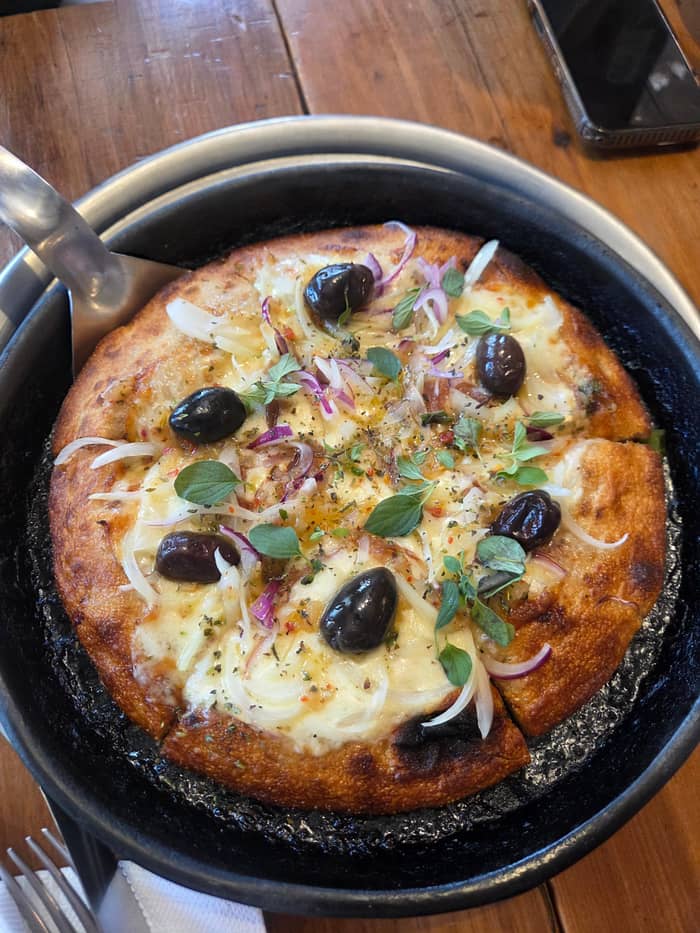
Pizza is where the Italian story turns local. The tourism board explains that pizza porteña grew under the influence of sfincione, a deep speciality of Palermo in Sicily.26 The house style is al molde: a thick, spongy base smothered with cheese and best shared with friends.3 Thin, stone-baked pies a la piedra and grill-cooked a la parrilla exist too, but the deep pan is the one to try first.27,28
Learn the menu words before you sit down. Muzzarella is the local margherita, cheese and tomato sauce, often with an olive on each slice.29 Fugazza is a thin pie piled with onion and no cheese at all, named after the Genoese word for focaccia.30 Fugazzeta keeps the onion but goes thicker and fills itself with cheese.31 The city credits the Banchero pizzeria in La Boca with inventing the fugazzeta, crossing onion fugazza with the cheese version.32
Then there is fainá, a flatbread of chickpea flour that came from Genoa.21 Many locals buy a slice with their pizza and eat them stacked, fainá on top.4 It sounds odd and tastes right, the nutty chickpea soaking up the cheese. Old pizzerias keep a standing bar for a quick slice on the way home from work, next to a seated room with waiters, so pizza here can be a quick stop or a long evening.33
Order with confidence
Match the hour and your appetite, and the plate picks itself.
If It is morning and I want coffee
Medialunas and a cortado
If I need something to eat while walking
Empanadas
Baked or fried, with fillings from ham and cheese to meat.1
If I want the biggest lunch in town
A milanesa a caballo
Ham, tomato, mozzarella and a fried egg on top.17
If It is late and I am with friends
Pizza al molde with fainá
If It is cold outside
Locro
Meat and corn stew, eaten in winter.23
If I only want dessert
Dulce de leche ice cream
The flavour Visit Argentina puts first.25
Plates for every mood
Snack or lunch
Hand-held and quick
Big lunch
The bodegón classic
Late dinner
Deep, spongy, cheesy
Breakfast in a porteño café is coffee with something sweet. The medialuna is the local croissant, and it comes in two kinds: a butter one with a shiny syrup glaze, and a saltier one made with beef fat.22 Fillings run to dulce de leche, quince paste or sugar and cinnamon, and the partner is coffee with milk or a round of mate.40 At a historic café the classic order is a cortado, an espresso cut with a dash of hot milk, with a medialuna on the side.11
Medialunas belong to a bigger family called facturas: vigilantes, churros, bolas de fraile and other pastries that keep company with mate and coffee in the morning and again in the afternoon.41 Churros deserve their own line: deep-fried, sugar-coated dough, frequently stuffed with dulce de leche and dunked in a cup of dense hot chocolate.36 The city tourism board names hot chocolate with churros at Café Tortoni as a winter classic.42
Then the alfajor. The classic is a pair of biscuits sandwiching dulce de leche and coated in chocolate; it has existed since colonial times and boomed as a packaged snack in the 1950s.24 The softer alfajor de maicena uses cornflour biscuits around the same filling.34 Buy a chocolate one at any kiosk to compare, then a maicena one from a bakery, and you will understand why people argue about them.
Taste it with a guide
Choose how many of you are eating and compare a food walk, a cooking class and a street food tour.
3 options compared
Choose how many of you are eating and compare a food walk, a cooking class and a street food tour.
≈
View≈
View≈
ViewGetYourGuide's starting prices, converted at the ECB reference rate; exact pricing appears when you book.
A day of eating
Dulce de leche is the flavour that ties the sweet side together. In 2002 the national Secretariat of Culture recognised it as part of Argentina's cultural and food heritage, and national figures put consumption at 2.2 kg per person a year.5,43 Production in 2023 reached 103,824 tonnes.44 Its world day falls on 11 October, a handy excuse if you are in town that week.45 Spread it on toast, spoon it from the jar or find it hidden in a pastry: it turns up at every meal.
You will find it inside almost every dessert. Bodegón menus serve flan with dulce de leche, fresh cheese with quince or sweet potato paste, pancakes and almendrados.35 The cheese and quince combination has a name, vigilante, and it is exactly that: a slice of each, stacked.46 The chocotorta, coffee-soaked chocolate biscuits layered with a mix of dulce de leche and cream cheese, is a classic of Argentine birthday parties.47
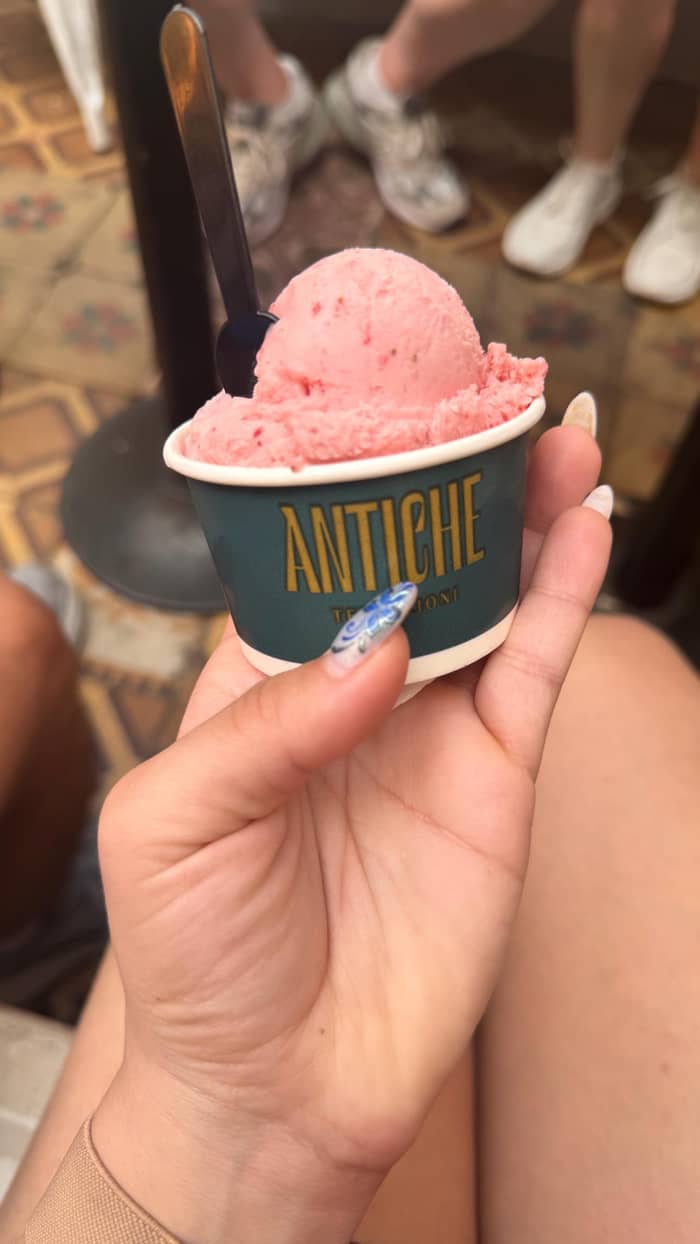
Ice cream is the other daily ritual, another Italian legacy. The tourism board notes a huge number of heladerías, from large chains to small makers with exotic flavours.48 Visit Argentina names dulce de leche as the quintessential flavour, followed by chocolate, tramontana, sambayón and mascarpone.25 Freddo, a chain founded in Buenos Aires in 1969, is one of the big names.49 Ask for a cone with dulce de leche granizado and you will fit right in.
Video
Julia Gonzales Travels on YouTube · Nothing is fetched until you hit play.
Porteños, the residents of Buenos Aires, love to eat out, and the city's dining scene is booming
Winter has its own dishes. Locro is a hearty stew of meat and corn from the Andean region; in Buenos Aires it is eaten mostly in the cold months and on patriotic holidays.23 Mondongo and carbonada are its traditional companions.50 These are slow, filling bowls, made for grey June afternoons rather than for summer terraces. On a national holiday you may also see pastelitos, crisp puff pastries filled with quince, which tradition puts on every table on 25 May.51
Some customs are pure fun. On the 29th of every month porteños eat ñoquis, potato gnocchi, and tuck a banknote under the plate to call in money.38 If your trip crosses that date, order the gnocchi and follow the ritual. For the old Spanish side of the menu, look for puchero, a boiled dinner of several meats and vegetables that places like El Globo and El Tropezón still treat as a flagship.52,53
And then mate, the drink you will see everywhere. The tourism board describes it as a caffeine-rich bitter herbal drink, sipped through a metal straw from a hollow gourd and shared among friends, with one person refilling and passing it round.39 It is part of the national heritage list together with Malbec, dulce de leche, the empanada and asado.54 If nobody offers you a gourd, a short guided tasting is the easiest way in.
Timing changes everything. The tourism board gives the usual windows as breakfast between 7 and 10 h, lunch between 12.30 and 15 h and dinner between 20 and 23 h.6 Restaurants usually serve lunch and then close until dinner, so a mid-afternoon craving belongs to a café.55 That café stop has a name, merienda: a late-afternoon coffee with a pastry or a slice of cake, served every day.12
So what time is dinner in Buenos Aires? Later than you think. Kitchens open for dinner at about 8 PM and keep serving past midnight.13 Arrive before 9 PM and you may have the dining room to yourself.37 The real rush begins at 9.30 PM, later still on weekends.14 If you are an early sleeper, make lunch your big meal and keep the evening for a light plate. A good plan is a late-afternoon merienda, a long walk, then a table booked for after 9.30 PM.14
Build the day around that clock and the local favourites fall into place: medialunas and a cortado in the morning, empanadas or a milanesa at lunch, ice cream or churros in the afternoon, pizza with fainá late in the evening. If you want it all in one go with someone to explain each plate, the Palermo food walk offered here visits 4 restaurants for at least 8 dishes, with the drinks included.
FAQ
Visit Argentina calls dulce de leche the quintessential flavour, ahead of chocolate, tramontana and sambayón.25
On the 29th of each month porteños eat ñoquis with a banknote under the plate to attract money.38
Cafés serve the merienda every day: a late-afternoon coffee with a pastry or a piece of cake.12
Mate is shared from one gourd and straw, with one person refilling and passing it round the group.39
Sources
Hungry in Buenos Aires? Ask a real person here.